
 Our morning routine often involves a shot of caffeine and during the day, whatever the reasons, we may need it again (and again) for an instant boost. But too much caffeine may cause an unpleasant nervousness. That's why Nestlé is looking for a way for the caffeine to be released more constantly rather than in one batch. To achieve this, Nestlé Research Center Lausanne's scientists are collaborating with the EPFL's (Ecole Polytechnique Fédérale de Lausanne) Interdisciplinary Centre for Electron Microscopy and EPFL's Institute of Cancer Research, as well as the Department of Health Science & Technology of ETH (Swiss Federal Institute of Technology) Zurich.
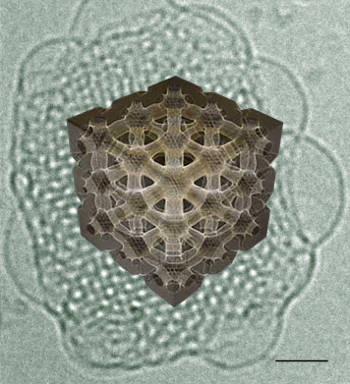
And they just discovered a technique that "can 'see' inside dispersed cubosomes (dispersed cubic liquid crystalline phases) with unprecedented detail. The breakthrough can help to improve their design significantly for better drug or nutrient delivery", as the EPFL explains, these cubosomes being “small biological 'capsules' that can deliver molecules of nutrients or drugs with high efficiency. This also means that cubosomes are safe to use in living organisms."
The aim is now to see how it is possible to use the cubosome's structure to deliver nutrients, medication or, precisely, caffeine, in a controlled and safe fashion. So, one day may be, we won't need more than just one cup of coffee in the morning, and still benefit from its boost all through the day.
Photo: 3D reconstruction of a cubosome obtained with CET. Scale bar: 40 nm ©Davide Demurtas/EPFL
News in the same category
Following a successful launch on the West Coast, the plant-based Impossible Burger is set to arrive on the East Coast.
Danny Trejo is far from being the first actor to launch a restaurant business, but when he says his tacos “are the most delicious tacos known to man”, he's so persuasive we can't help but believe him.
There is a new branch of Nekter Juice Bar opening in Costa Mesa. The chain, which is starting to build a huge customer base in California is popular for its handcrafted juices, smoothies and acai bowls.
Chick-fil-A, the well-known Atlanta fast food chain, have done it again by opening another branch in Colorado Springs in the northeast region of the city.